
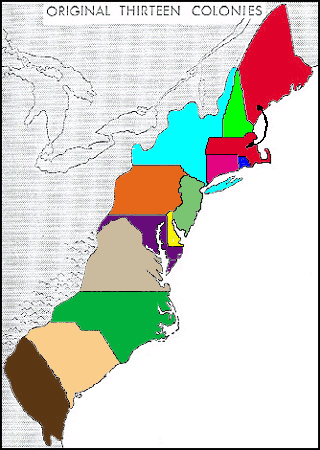
Many feel that The United States (plural) became The United States (singular) following the Civil War. In fact the war was primarily fought over the question of whether any of the states had the right to separate, or secede, from the rest. The war's result being a reunified nation, it was felt that the question had then been settled: we are one nation, The United States of America. It became official in 1902 when the House of Representatives' committee on revision of the law ruled The United States should be treated as a singular, not a plural term.
So what does this mean for us and what does it have to do with this evening's debate? My take on it is this: We live in the 21st century and the country has come a long way from the 18th century frontier nation that was formed out of necessity as a sort of coalition against a strong-handed monarch on another continent. Today we are Americans much more than New Yorkers, Michiganders, Californians or Texans. We move easily from state to state. The very term of 'state' means to us a subset of our nation rather than an independent entity. We have progressed from an infant, frontier, democratic experiment of a nation to a world-leading economic, military and industrial powerhouse. I doubt we could have accomplished this as a collection of 50 independent states.
I believe it is inevitable that a strong nation will grow more centralized over time. Progress demands that laws, customs, transportation systems, manufacturing and trading opportunities be uniform and free from obstruction within a country's borders. To accomplish this there must also be a strong government entity to oversee and regulate commerce in a way that assures smooth business transactions throughout the nation. Any difference in laws or regulations among the states only serves to impede the smooth operations necessary for progress.
This brings me to the crux of my argument. One of our great political parties is commonly referred to as progressive, while the other is self-proclaimed as conservative. To me these two terms serve well to indicate the overriding attitudes of the two parties. "Progressive" implies moving forward, making the changes necessary to advance. On the other hand, the root of "conservative" means to keep or preserve the current state of affairs. This is the party we hear calling us to adhere to the constitution and to the intents of our founders (looking backward). The other accepts that the world is changing and that our attitudes and practices sometimes need to reflect this (looking forward). The ideal of strong local and state governments may be quaint and out of touch with the needs of today's realities. I question the wisdom of having differing statutes by state on matters such as voting age, driver licensing, marriage requirements or education standards and funding. This ties to one of my earlier posts where I suggested it may be time to rewrite our 18th century constitution to bring our nation's legal system up to the times in which we live.
I hope this piece makes sense. I've tried to put my thoughts down in a way that can be followed and understood. You can agree or disagree -- that's the purpose of this site! And that's what makes the USA a great country. Maybe these lines will help you to decide how to vote next month. Just be sure to VOTE, and thanks, as always, for reading my humble post.

No comments:
Post a Comment